

How a Massachusetts town went from national housing model to political flashpoint — and what it means for buyers, sellers, and residents in 2026.
Introduction
Few Massachusetts suburbs have seen their zoning policy make national headlines quite like Lexington, MA. In 2023, this affluent Boston suburb became one of the very first communities in the state to comply with the MBTA Communities Act — and it didn't stop at the bare minimum. Lexington went big, rezoning huge swaths of town for dense, multi-story housing near transit.
Three years later, the story has taken a dramatic turn. What began as a celebrated housing success story has evolved into one of the most closely watched zoning rollbacks in Greater Boston. If you own property in Lexington, are considering a move there, or are simply following the region's ongoing housing debate, here's what you need to know about the MBTA Communities zoning saga and where things stand today.
What Is the MBTA Communities Act?
The MBTA Communities Act is a Massachusetts state law requiring cities and towns served by, or near, the MBTA transit system to zone at least one district for multi-family housing by right. The goal is straightforward: ease the region's housing shortage by encouraging denser development near public transit.
Lexington had a choice, like every other MBTA community, in how aggressively to comply. It chose to go well beyond what the state required.
Lexington's Ambitious 2023 Rezoning
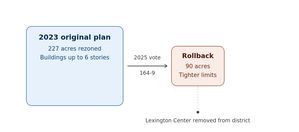
In 2023, Lexington's Town Meeting approved a sweeping rezoning plan covering roughly 227 acres, including parts of the town center and office parks near Route 128. The plan allowed buildings as tall as six stories, with density limits far more generous than the state's minimum thresholds.
The move earned Lexington a reputation as a trailblazer. National media outlets took notice, and the town was even the subject of a favorable New Yorker feature describing it as a Massachusetts town charting a path out of the state's housing crisis, according to reporting from Boston Street Pulse. State officials praised the plan as a model for other communities to follow.
For a town of about 35,000 residents that had seen very little new construction in decades, it was a striking shift in direction.
 The Backlash: When Ambition Meets Reality
The optimism didn't last. Within two years, more than 1,097 housing units had been proposed under the new zoning — a volume of development that caught many residents off guard, as reported by Bisnow.
Concerns began mounting over:
- School enrollment capacity — worries that rapid population growth would outpace what local schools could absorb
- Infrastructure strain — questions about whether roads, water, and sewer systems could keep up
- Neighborhood character — anxiety over preserving the look and feel of Lexington's historic center
- Municipal services — general concern about growth outpacing the town's ability to provide services
A resident-led petition argued the town needed to slow down and plan more deliberately before allowing further large-scale development. The pushback culminated in a Town Meeting vote to significantly scale back the original zoning — shrinking the overlay district from 227 acres to approximately 90 acres and tightening both height and density restrictions. The rollback passed by an overwhelming margin, 164 to 9, with five abstentions.
Notably, Lexington Center — one of the most fiercely debated areas in the original plan — was removed from the multi-family overlay district entirely.
 Where Lexington Development Stands Today
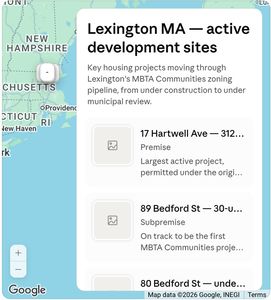
Despite the rollback, the development pipeline hasn't stopped — it's simply moving through a narrower, more tightly controlled zone. Here's a snapshot of the current landscape:
The Big Picture
Lexington is still on track to add approximately 1,600 new apartments and condominium units across projects that are under construction, already approved, or working their way through the approval process, according to Boston.com. That's a substantial volume of new housing for a town that saw minimal construction for decades.
A Boston Indicators analysis found that Lexington leads all Massachusetts MBTA Communities in development activity, with 1,286 units spread across 12 separate projects — putting it well ahead of peer towns navigating the same state mandate.
Notable Active Projects
- 17 Hartwell Ave — a large-scale, 312-unit residential development currently under construction
- 89 Bedford St — a 30-unit condo project positioned to become the first MBTA Communities development in Lexington to reach completion
- Belfry Hill area mixed-use project — a proposed four-story building with more than 50 homes, still awaiting sign-off from the town's Historic Districts Commission given its proximity to a Revolutionary War-era landmark
- "The Lex" — a 32-unit affordable condominium project allocated through a public housing lottery
Projects Under Municipal Review
- 80 Bedford Street — currently going through Village & Multi-Family Site Plan Review
- 439 Marrett Road — also in Village & Multi-Family Site Plan Review
- 16 Clarke Street — already approved and moving forward
Ongoing Tension Points
Even with the scaled-back zoning in place, friction hasn't disappeared. Residents have raised specific concerns about flooding risks tied to the 89 Bedford Street project, along with broader worries about school enrollment, infrastructure capacity, and maintaining the character of Lexington's historic district as new construction continues.
What This Means for Buyers, Sellers, and Residents
For prospective buyers: More housing supply — even at a reduced pace — could eventually ease some of the intense competition that has defined Lexington's single-family market. Condo and rental buyers in particular may want to watch how the influx of new units along corridors like Hartwell Avenue affects pricing and availability over the next few years.
For current homeowners: The zoning rollback signals that large-scale, six-story development is no longer the likely norm across most of town. That said, Lexington Center's exclusion from the overlay and tighter density rules elsewhere suggest future growth will be more incremental and geographically concentrated.
For residents watching the process: The debate over growth versus preservation is far from settled. With the state actively enforcing the MBTA Communities Act elsewhere in Massachusetts — including lawsuits filed against non-compliant towns in early 2026 — Lexington's experience is likely to remain a reference point in the statewide conversation about how much density transit-adjacent suburbs should absorb, and how fast.
Local Expertise: What the Noune K Group Is Watching
At the Noune K Group, we've been guiding buyers and sellers throughout Greater Boston since 2011, and Lexington's zoning transformation is one of the most significant shifts we've tracked in the local market in years. We believe real estate decisions should be made with clear information — not headlines — so here's what we're telling our clients as this story unfolds.
A few things we're advising clients on right now:
- Verify zoning status before you fall in love with a listing. Some homes marketed as being in the MBTA Communities overlay are no longer inside it after the 2025 rollback. We check this on every property we show.
- Timing matters, especially for condo buyers. With roughly 1,600 units in various stages of the pipeline, entering the market now versus waiting for more inventory can mean very different outcomes — we'll walk you through the trade-offs based on your goals.
- Pricing strategy should reflect proximity to development. Homes near Hartwell Avenue or the Bedford Street corridor are seeing different buyer behavior than those further from the overlay district, and any pricing strategy we build is backed by that local data.
- We monitor Planning Board activity so you don't have to. Because outcomes at sites like Belfry Hill and 16 Clarke Street can affect surrounding home values, we keep an eye on municipal review status and flag anything relevant to your search or your home's value.
This is exactly the kind of nuance we believe matters — honest guidance, grounded in real data, without the pressure. Whether you're considering a sale in Lexington or exploring a move into town, we'd welcome the chance to listen to your goals and help you navigate what comes next.
The Bottom Line
Lexington's MBTA Communities journey is a case study in the real-world complexity of ambitious housing policy. A plan once celebrated as a national model ran into the practical realities of rapid growth — schools, infrastructure, flooding, and neighborhood character — and the town course-corrected through local democratic process rather than abandoning multi-family housing altogether.
The result is a middle path: substantial new housing still coming online, but within a narrower, more tightly managed footprint than originally planned. For anyone tracking Lexington real estate, keeping an eye on individual project approvals — particularly at 80 Bedford Street, 439 Marrett Road, and the Belfry Hill site — will offer the clearest signal of where the town's growth story goes next.
Ready to talk? Nouné Karapetian, REALTOR®, Compass — 617.256.7097 Allen Babroudi, REALTOR®, Compass — 617.388.9601 📧 [email protected] | 🌐 nounek.com
Keywords: Lexington MA real estate, MBTA Communities Act Lexington, Lexington zoning changes, Lexington MA new construction, Lexington housing development 2026, Lexington MA multifamily zoning
Check out this article next