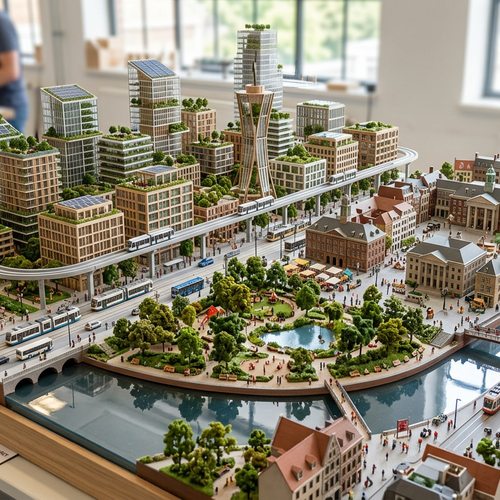

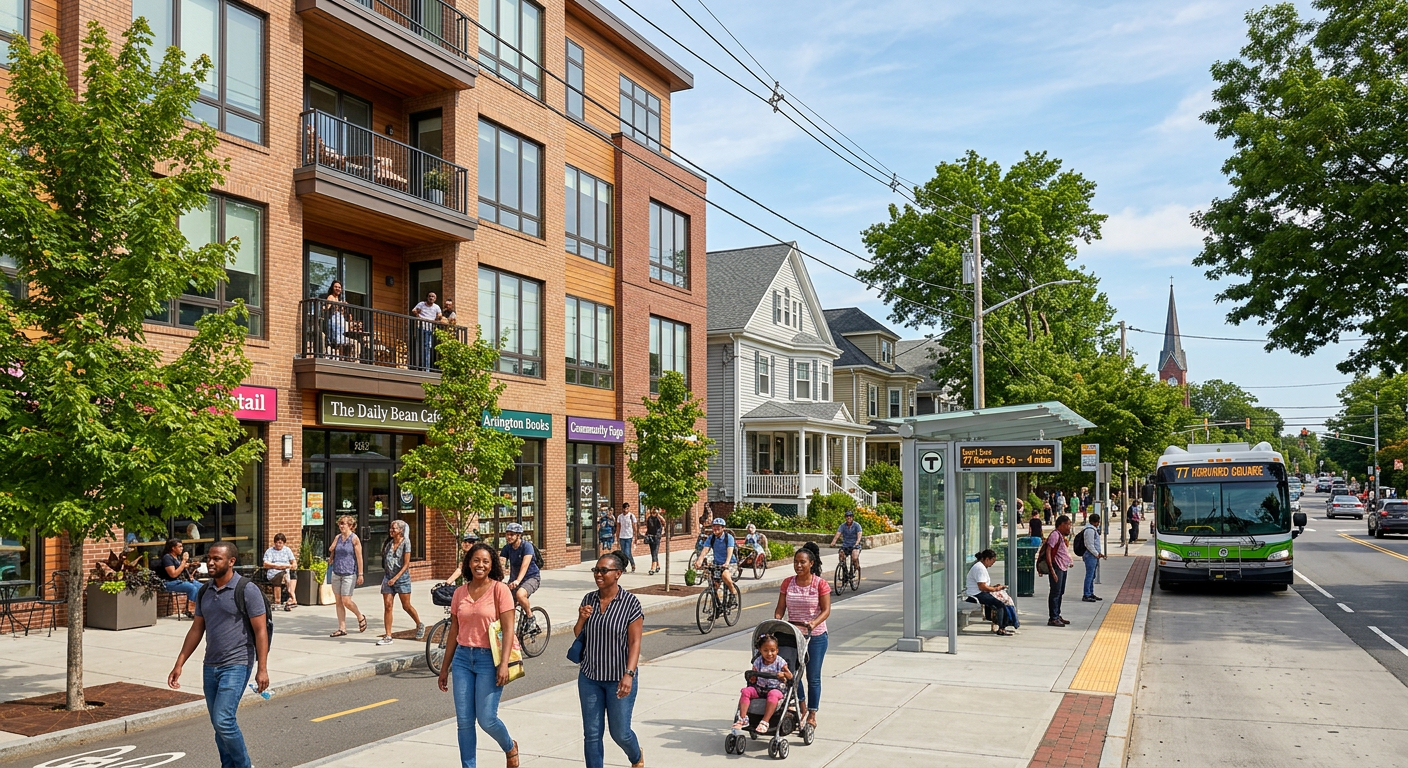
Back in October 2023, Arlington's Town Meeting approved the MBTA Communities Overlay District — the town's answer to the state law requiring transit-served communities to allow multifamily housing by right. That zoning is now fully in effect, and it's starting to show up in real projects, not just plans on paper.
We work these corridors block by block, and we're already seeing this overlay change how buyers, sellers, and investors need to think about property along Mass Ave and Broadway. Here's the breakdown — and how we help clients navigate it.
The Short Version
- Where it applies: A mapped set of parcels concentrated along Massachusetts Avenue and Broadway, primarily in the town's business corridors.
- What it allows: Three- and four-story apartment buildings by right — no special permit needed — with five or six stories possible if a project sets aside 25% of units as affordable housing or includes ground-floor commercial space.
- Why it matters for value: If your property — or one you're considering buying — sits inside the overlay, its development potential (and therefore its price) may be significantly different than the old zoning would suggest. This is a parcel-by-parcel question, so it's worth checking before you list or make an offer near these corridors.
- The scale: Arlington was required to zone capacity for roughly 2,046 multifamily units — about 10% of its existing housing stock — and the overlay covers roughly 115 acres running along the town's highest-frequency bus routes from East Arlington to Arlington Heights.
Why This Isn't Just a Planning Story — It's a Pricing Story
Most homeowners think of zoning as background noise: something that shows up in a town meeting agenda, not something that moves their equity. On Mass Ave and Broadway right now, that's no longer true.
A single-story storefront or an aging two-family that used to be valued purely on its current use can suddenly be worth a very different number to a developer once you factor in by-right multifamily potential. We've started running "as-is vs. as-zoned" comparisons for corridor-adjacent sellers, because the two numbers are diverging — sometimes significantly.
The reverse is also true for buyers: a property that looks like a quiet residential purchase today may sit next to, or even within, a parcel where a four- to six-story building could rise in the next few years. That's not automatically a problem — new multifamily can bring better retail, more foot traffic, and long-term neighborhood investment — but it's something you should decide on knowingly, not discover after closing.
How We Help Clients With This
This is exactly the kind of local, parcel-level knowledge that separates a general market update from real guidance:
- Parcel verification. Before you list or write an offer near Mass Ave or Broadway, we check whether the specific parcel — and its immediate neighbors — falls inside the mapped overlay district. Overlay boundaries follow an adopted parcel list, not a simple "distance from the street" rule, so this isn't something to eyeball from a map.
- Highest-and-best-use context for sellers. If your property carries by-right multifamily potential, we make sure that's reflected in how we position and market it — including outreach to developers and investors, not just owner-occupant buyers.
- Due diligence for buyers. If you're purchasing near the overlay, we walk you through what could realistically be built nearby, on what timeline, and what that might mean for parking, light, and street character — so there are no surprises two years after you move in.
- Investor guidance. For clients evaluating corridor properties as investments, we help pencil out scenarios under the new by-right rules versus the old special-permit process, since the math has changed meaningfully for anything inside the overlay.
A Few Things Worth Remembering
- The overlay doesn't touch every property near the corridors. It applies to a specific, adopted parcel list — a home two streets off Mass Ave may or may not be included, and the only way to know is to check.
- The overlay avoids floodplains and historic districts. So not every commercially zoned or corridor-adjacent parcel is a candidate for redevelopment; the town carved out protected areas intentionally.
- This is still early innings. Projects like the recently approved Emma's Court development (840–846 Mass Ave) show the overlay moving from policy to construction — expect more of these to surface over the next few years as sites turn over.
Thinking About Buying or Selling Near Mass Ave or Broadway?
Whether you're weighing what your corridor-adjacent property is really worth, or trying to understand what might get built near a home you're considering, this is a conversation worth having before you make a move — not after.
Ready to talk? Nouné Karapetian, REALTOR®, Compass — 617.256.7097 Allen Babroudi, REALTOR®, Compass — 617.388.9601 📧 [email protected] | 🌐 nounek.com
Arlington MA MBTA Communities Overlay, Arlington MA zoning 2026, Mass Ave Arlington development, Broadway Arlington MA development, Arlington MA multifamily zoning, Arlington MA by-right multifamily housing, Arlington MA real estate development, Arlington MA property value corridor, Arlington MA real estate agent, Arlington MA investment property, Arlington MA real estate expertise
Check out this article next