
Belmont MA MBTA Communities Act (3A) Zoning: What the Final Approval Means for Homebuyers and Investors
Belmont's MBTA Communities 3A zoning is now finalized, allowing multifamily housing by right in Belmont Center and Waverley Square. Here's what it means for buyers, sellers, and investors.
If you've been watching the Belmont, MA real estate market, you've probably heard the term "3A zoning" thrown around at town meetings, in local news, or by your real estate agent. It's not just bureaucratic language — it's one of the most significant structural changes to hit Belmont's housing market in decades, and it's now official.
Belmont has completed its compliance with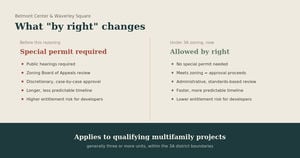 the Massachusetts MBTA Communities Act, finalizing 3A zoning districts in Belmont Center and Waverley Square. Multifamily housing is now allowed by right in these districts, meaning developers no longer need a special permit to build. For a town long defined by single-family zoning and tight housing supply, this is a real shift — and it's worth understanding whether you're buying, selling, or investing in Belmont real estate.
At the Noune K Group, we've been working the Greater Boston market since 2011, and we've watched Belmont go through smaller zoning debates before — but nothing on this scale. We're already fielding questions from sellers near Waverley Square who want to know what their property is actually worth now, and from buyers who assumed Belmont's tight inventory meant no new options were coming. Below is our honest read on what this zoning change means, not just what it says on paper.
What Is the MBTA Communities Act, and Why Does It Apply to Belmont?
The MBTA Communities Act (Section 3A of the Massachusetts Zoning Act) requires cities and towns served by MBTA transit — including commuter rail communities like Belmont — to zone at least one district where multifamily housing is permitted by right. The goal is straightforward: increase housing production near transit to address the state's broader housing shortage.
As a commuter rail community, Belmont was required to zone for a capacity of roughly 1,632 multifamily units, which represents about 15% of the town's existing housing stock. Towns that fail to comply risk losing eligibility for state grant funding and can face legal exposure — a risk that became very real for other Massachusetts towns that pushed back on the law.
Belmont's Path to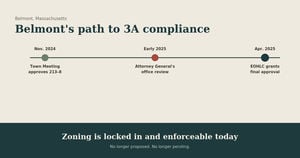 Compliance: A Timeline
Belmont's 3A zoning didn't happen overnight. Here's how it unfolded:
- November 2024 — Town Meeting approved the 3A zoning map by a decisive 213–8 vote.
- Early 2025 — The plan cleared review by the Massachusetts Attorney General's office.
- April 2025 — The Executive Office of Housing and Livable Communities (EOHLC) granted final state approval, officially certifying Belmont's compliance.
That approval process matters for buyers and developers alike: it means the zoning is no longer proposed or pending — it's locked in and enforceable today.
Where the New Zoning Applies
The 3A rezoning covers approximately 50 acres across two districts:
- Waverley Square — roughly 27 acres, the larger of the two districts and the one carrying most of the required density.
- Belmont Center — the remaining acreage, concentrated around the town's commercial core and commuter rail station.
Because the zoning boundaries are parcel-specific — and some individual lots are excluded even within the districts — the only reliable way to confirm whether a specific property qualifies is to check it against the town's official adopted zoning map, not general neighborhood boundaries.
What "By Right" Actually Means for Buyers and Developers
This is the detail that matters most. Before this rezoning, multifamily projects in these areas typically required a special permit — a discretionary, often lengthy approval process subject to public hearings and Zoning Board of Appeals review.
Under the new 3A districts, qualifying multifamily projects (generally three or more units) can move forward as of right, provided they meet the dimensional and use requirements already written into the zoning. That removes a major layer of uncertainty and delay for developers, which is exactly the point of the state law — reduce friction to get more housing built near transit.
Why This Matters If You're Buying or Selling in Belmont
For homebuyers: Properties in or near the newly zoned districts may see increased development interest over time, which can affect everything from streetscape and traffic patterns to the long-term character of the neighborhood. If you're evaluating a home near Belmont Center or Waverley Square, it's worth asking whether adjacent parcels fall inside the 3A district.
For sellers and property owners: If your property sits within the rezoned area, its underlying value may reflect new development potential — particularly for owners of underutilized commercial parcels or aging multi-family buildings that could be redeveloped at higher density.
For investors: By-right multifamily zoning significantly de-risks the entitlement process, which is often the slowest and most expensive part of a development timeline. Waverley Square, with its larger rezoned footprint, is likely to be the area to watch first.
Our Take: What This Means for Our Clients
Allen's background includes 20-plus years managing complex, multimillion-dollar programs for companies like AWS, Dell, HP, and CGI, along with hands-on experience in property management and home renovations. When we look at a rezoned parcel, we're not just checking whether it qualifies — we're evaluating whether it's actually a realistic redevelopment candidate given lot size, existing structure condition, and access, or whether the zoning bump is more of a long-term value story than a near-term one.
Our honest advice to sellers with property inside the 3A districts right now: don't assume "by right" multifamily zoning means an instant windfall. It's a real factor in your pricing strategy, and we'll back that into our market analysis, but the timeline for anyone actually pulling permits and building depends heavily on financing conditions and construction costs, not just what the zoning bylaw allows. We'd rather walk you through that nuance honestly than oversell the upside.
For buyers, our guidance is the opposite of what most people assume: a home just outside the rezoned boundary can sometimes be a better long-term hold than one inside it, since it benefits from neighborhood investment without the uncertainty of what gets built next door. We look at proximity to the district, not just inclusion in it, when we're advising clients on what to offer.
Zoning Approval Doesn't Guarantee Construction
It's worth tempering expectations here. Zoning capacity is not the same as active development. Belmont's own developer outreach has found that current commercial real estate conditions in the Boston and Cambridge area — including elevated office vacancy and thin margins on ground-floor retail — make near-term construction less certain, even with the zoning hurdle cleared. In other words: the door is open, but that doesn't mean projects will walk through it immediately.
Belmont's 3A rezoning is also just the first of several local zoning efforts underway. The town has since pursued its own Belmont Center Overlay District and is now working on a Hill's Crossing Overlay District along Brighton Street — both separate from the state-mandated 3A zoning but part of the same broader push to modernize Belmont's development rules.
The Bottom Line
Belmont's MBTA Communities 3A zoning is no longer a proposal — it's finalized, state-approved, and actively shaping how roughly 50 acres of the town can be developed. Whether you're house-hunting, selling a property, or evaluating investment opportunities in Belmont Center or Waverley Square, understanding these zoning boundaries — and the by-right development rules now in place — is essential to making an informed decision in this market.
If you're considering a purchase or sale near either district, we're glad to walk you through which specific parcels are affected, what it could mean for your property's value, and how to plan around it — with no pressure and no sales pitch, just honest guidance backed by local market data.
About the Authors
Noune Karapetian has been helping buyers and sellers throughout Greater Boston since 2011. Before real estate, she founded and directed Bell Music School for more than 20 years while performing with local opera companies — experience that shaped the patience, careful listening, and attention to detail her clients rely on today. Noune has deep knowledge of the Belmont market, from home values to the neighborhoods, schools, and lifestyle that make each community unique.
Allen Babroudi brings more than 20 years of leadership experience managing complex programs and multimillion-dollar initiatives for global companies including AWS, Dell, HP, and CGI. His background in project management, negotiations, property management, and home renovations gives clients a practical, strategic read on a property's potential — including how zoning changes like this one factor into value.
Together, they lead the Noune K Group, where success isn't measured by the number of homes sold, but by the trust earned and the relationships built along the way.
Keywords: Belmont MA 3A zoning, Belmont MBTA Communities zoning, Belmont Center rezoning, Waverley Square zoning, MBTA Communities Act Massachusetts, multifamily housing by right, Belmont MA real estate development, Belmont Center Overlay District, Belmont MA housing market 2026, Belmont MA homes for sale, Belmont MA real estate agent
Check out this article next